
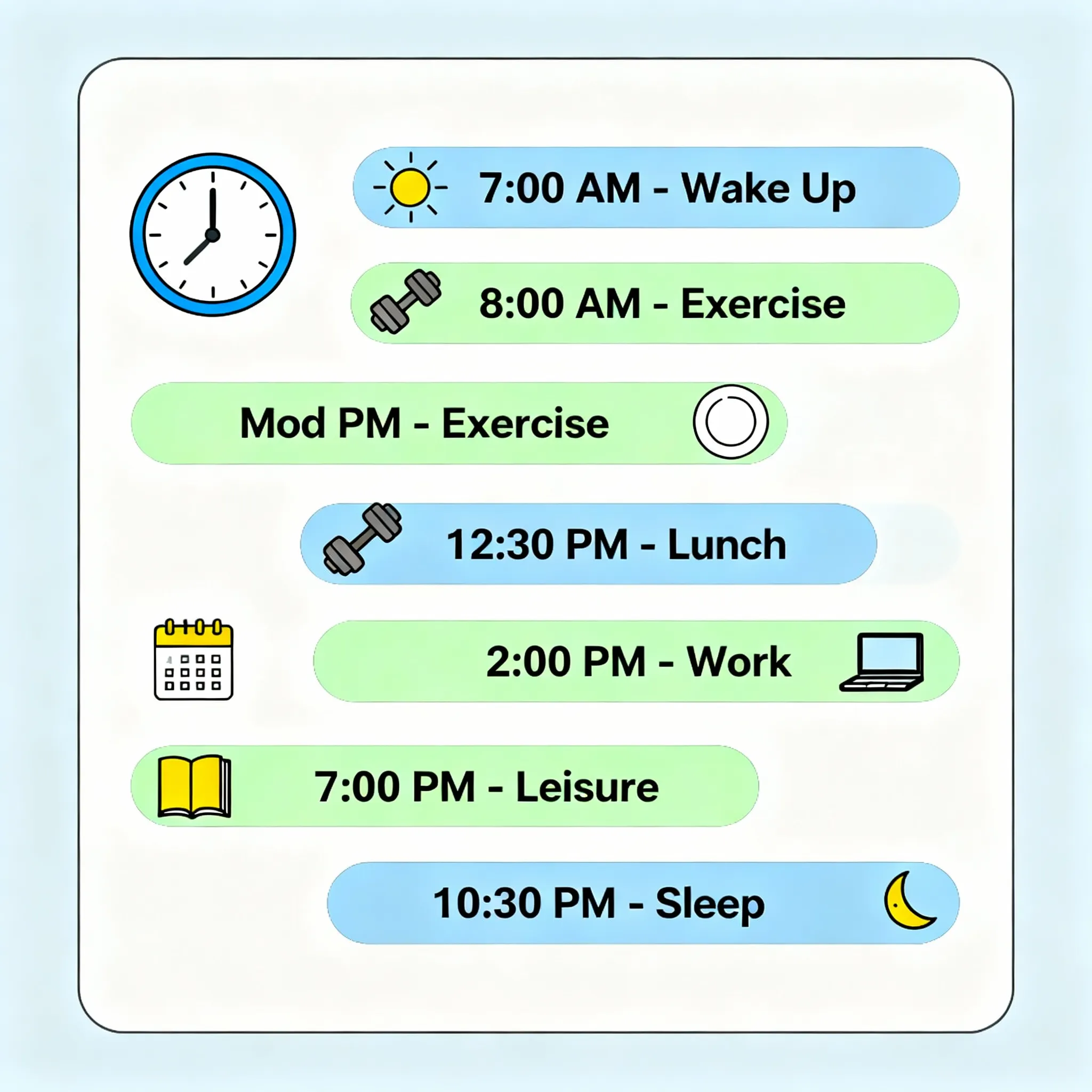
What is a daily schedule?
It is the plan for the entire day which includes all the activities at a stipulated time. It includes what time a person wakes up, at what time they eat, what time they go to work. This also includes time for exercise and recreational activities. It includes time for household chores as well as makes provision for enough sleep. Thus it covers all the main lifestyle pillars.
Having a regular daily schedule is very helpful for overall health. This schedule helps ensure that all the important activities are included at the correct time in the entire day. This way we gain dual benefits.
- One is the cyclical regularity is helpful for our circadian rhythm
- Two is that all important activities are covered which help in over all good health.
The daily schedule should include meal times, timing of sleep, exercise, entertainment or recreation activities, time for stress management and of course time for work. When adequate time is devoted for each lifestyle pillar in the entire day, it helps improve health and prevent illness.
Let us see how to build our ideal schedule.
Following are general pointers and each one has to modify as per personal requirements, yet staying within the limits which promote good health.
Start with calculating how much sleep we would need. Typically a healthy adult will need 7-9 hours of sleep.
Then consider at what time you need to start your day in order to do the morning routine before starting work. This wake up time should ideally match the circadian clock. Meaning it is important to wake up and start the day between 5am to 7am preferably. Delaying wake up time beyond that will lead to a circadian mismatch. (Exceptions are those working in shifts or as per international time zones. These individuals need to work with their health care providers to work on an ideal schedule for them)
Once the wake up time is decided, now calculate back to know the sleep time. This is the time a person should go to bed. Eg. If wake up time is 6am and a person needs 8 hours of sleep, then this person should go to bed at 10pm.
The night routine should begin about 30-45 minutes prior to sleep time. It is ideal to avoid all sort of screens atleast 2 hours prior to sleep time. I shall discuss a healthy night routine in subsequent blogs. But it is important to plan our day such that we are able to give enough time to wind down before sleep. This helps promote a deep rejuvenating sleep. It is best to plan for this and avoid jumping into bed right after frenetic activity involving work and screens.
Depending on each person’s work schedule, it is important to plan for exercise. Ask yourself how much time can you find for exercise? It can be as less as 5-10 minutes or can be upto 60-80 minutes. It can be a continuous patch of time devoted to exercise or can be divided into 2 or 3 spans of 10-30 minute each.
Based on this we can plan an exercise routine for ourselves. Some people enjoy exercise in the early morning before work begins. This starts the day on an energetic note. In contrast some people find evening exercise to be more helpful. It helps them de-stress after work. Find out your preferences and plan accordingly. As per the circadian rhythm, the best time to exercise is between 2-4pm but that is not possible for most of us. Hence it is important to try and do as much as possible and not worry too much to achieve perfection. The exercise time and routine should be such that it is enjoyable and sustainable. Once consistency is achieved, that helps build good habits and good health. I shall elaborate more on exercise plans in subsequent blogs.
The next step is to chalk out the actual work hours. Then go on to fit in meal times in between these, such that there is adequate gap between 2 meals. Each body is different and some people feel hungry every 2-3 hours where as some people can go upto 5-6 hours between meals. It is important to understand our biology without the external distractions. Ask these questions before deciding the eating pattern.
- Do I feel hungry immediately on waking up?
- How often do I eat? Is this driven by habit and convenience or genuine hunger?
- Is it hunger or thirst? Is it real hunger or craving?
It is important to connect with ourselves to block out the external noise of food fads, cravings, processed food advertising and social media influence. Even after this, it will take a few attempts to fine tune the eating pattern and timings. So go slow and don’t expect perfection. It is important to have slow progress rather than stress over the perfect schedule and end up doing nothing. Be open to modifications if a certain pattern does not work for you.
Typically a healthy adult will need 3-4 meals a day.
- Breakfast
- Lunch
- Evening snack
- Dinner
An additional snack can be had if breakfast is very early and lunch is bit later in the afternoon. Alternately evening snack can be combined with an early dinner if that works for you. So it ultimately depends on your work timings, hunger, exercise timings and sleep time.
While planning meal times, certain factors need to be considered.
- Find out when you get hungry after waking and have breakfast at that time.
- Most people find it best to exercise after a light snack. So if exercising in morning, have a fruit and some light carbohydrate snack before exercise and have the main breakfast post exercise.
- Keep a gap of atleast 3 hours between meals. Also try to assess when next you feel hungry after the previous meal.
- If you are exercising in the evening, try to have a gap of atleast 2 hours between a light meal and exercise. A gap of 3 hours is preferred if a meal is particularly heavy. Avoid exercising on a full stomach immediately after a meal.
- Try to have a gap of 2-3 hours atleast between dinner and bedtime. This helps better digestion of food and promotes good sleep quality.
Sharing an example of a daily schedule for a sedentary office goer who works 9-5 and prefers morning exercise and needs 7-8 hours of sleep.
- Wake up 6.30am
- Pre exercise fruit 6.35am
- Exercise 7-8am
- Breakfast and get ready 8.30am
- Go to work 9am
- Movement break 5 minutes every 60 minutes (walking around, stretching etc)
- Lunch 1pm
- Evening snack 4pm
- Back to home 5pm
- House work/ dinner prep/ leisure activities 5.30-7.30pm
- Dinner 7pm-7.30pm
- House work or hobby/ post dinner walk 7.30-8.30pm
- Winding down and bedtime ritual 8.30-10.30pm
- Sleep 10.30pm
Subsequent blogs will cover guidance about what to plan for each meal and how to factor in details like travel time and house chores.
The beauty of having a streamlined daily schedule is that it gives one enough time for all activities. Once we get into the habit of following a reasonably fixed schedule for most days of the week, we can find some flexibility during weekends and holidays. But it is important to not vary the timings of sleep and meals by more than 1-2 hours on a work day and weekend. Lesser the variation, better the health outcome.
So do follow the steps explained and plan your own unique routine. Hope this helps you build your ideal schedule for consistency and good health.
No Comments